

May is National Arthritis Awareness Month! So, it’s the perfect opportunity to raise awareness of the different types of arthritis, what causes arthritis, and what treatments are available – especially the significant role physical therapy plays in helping you stay active now and into the future if you suffer from osteoarthritis.
If you’ve already been diagnosed with arthritis, it is not too late! It might seem like arthritis is controlling you, but you can be in control of your symptoms. Now is the time to take action! You have the power to stop arthritis in its tracks by partnering with your physical therapist.
What Is Osteoarthritis?
Osteoarthritis (OA) is a degenerative joint disease (DJD) that is more likely to develop as people age. There are two main types of OA:
- Usually affects the fingers/hands, spine, hips, knees, and ‘big’ toe.
- Occurs because of a pre-existing abnormality in the joint, such as caused by injury or trauma in the past. Other causes include gout, genetic disorders in the joint, Ehlers-Danlos, or similar hypermobility disorders.
What Causes Osteoarthritis?
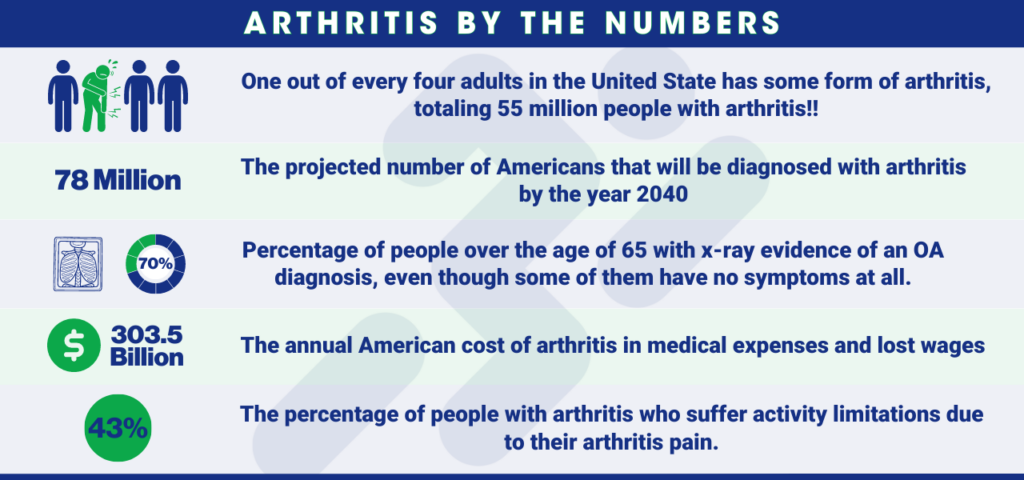
Osteoarthritis is the most common form of arthritis, affecting over 32 million people in the US. Nearly 70% of people over 65 have x-ray evidence of an OA diagnosis. It is essential to note that OA does not happen because of simple wear and tear on the joints. So, if you think being inactive can prevent OA, it’s quite the contrary. Instead, changes in the joint (where two or more bones come together) can trigger the breakdown of cartilage, which usually happens gradually over time.
Other causes of OA include:
- Joint injury or previous surgery: OA can begin due to damage caused by an injury to a joint or following surgery that impacted a joint of the body.
- Age: The risk of developing OA increases as you age.
- Genetics: Those with family members with OA are more likely to develop this condition.
- Body weight: Being overweight or obese increases the stress on joints, thus increasing the likelihood of OA.
- Pre-existing Conditions: Gout, rheumatoid arthritis, and hyper-mobility disorders such as Ehlers-Danlos increase OA incidence.
Six Signs & Symptoms Of Osteoarthritis
OA most commonly affects the spine, knees, hips, and hands. Some common symptoms include:
- Pain during or after movement of the impacted joint
- Stiffness and loss of joint motion, usually occurring in the morning or after a period of resting that area
- Swelling and immobility of the joint or area surrounding the joint
- Feeling that the joint is weak, loose, or unstable
- Tenderness with light pressure to or near the joint
- A grating sensation in a joint with movement, including popping or crackling sounds
Busting Osteoarthritis Myths
If you have OA, there’s nothing you can do about it, right? Wrong! In fact, there is a lot you can do to lessen the impact OA has on your life.
When your joints and muscles are aching, getting up to exercise might be the last thing you want to do. But it has been proven that physical activity is essential for managing OA.
Consistent, low-impact exercise can:
- Strengthen the muscles surrounding your affected joint
- Prevent bone loss
- Diminish swelling, stiffness, and pain
- Replenish the lubrication to the cartilage of the joint
- Aid in weight management to keep added pounds from increasing joint stress
Leading a lifestyle that omits exercise and movement does not decrease your likelihood of developing OA. In fact, if you get diagnosed with OA, inactivity makes your OA more painful. So, when your doctor or physical therapist tells you that ‘movement is medicine,’ they mean that exercise, when done correctly, is considered the most effective, non-drug treatment for reducing pain and improving mobility in patients with OA.
What’s Next? Ask Your Doctor for a Physical Therapy Referral
When it comes to OA, movement is a drug-free medication, and you have complete control. While OA is a chronic condition, you can stay one step ahead of your pain with an active lifestyle. And when your goals change or your function shifts, your treatment plan can evolve to keep up with your changing life.
As your partner in health, we know getting back to exercising after months (or years) of inactivity and pain can be a bit daunting. But rest assured—your physical therapist knows exactly where to start and how to help you get on the road to health and wellness. Ready to fill your fitness prescription? Talk to your doctor about a referral to MVPT Physical Therapy! Don’t delay your care, especially when it can help you get moving and on the road to health and wellness
Call any MVPT Physical Therapy location to schedule or complete the form below to request an appointment.
Resources:
- https://www.healthline.com/health/osteoarthritis-prevention
- https://www.hopkinsarthritis.org/patient-corner/disease-management/role-of-exercise-in-arthritis-management/
- https://www.arthritis.org/health-wellness/healthy-living/physical-activity/getting-started/benefits-of-exercise-for-osteoarthritis
- https://www.health.harvard.edu/staying-healthy/exercise-rx-for-overcoming-osteoarthritis
- https://www.cdc.gov/arthritis/basics/physical-activity/index.html
- https://www.healthline.com/health/how-to-ease-osteoarthritis-pain